How To Craft Wool Slabs & Sound-Dampening Blocks
Discover how to craft Wool Slabs in Minecraft 26.3 for effective sound dampening, these new items can enhance your gameplay like no other.

Shahrukh Sial is a Gaming Content Strategist at Sparked Host. He identifies his own strategic outlines through deep research to cover game guides, tips, and updates that help players improve their skills and enjoy a better gaming experience.
Quick Answer: Wool Slabs in Minecraft 26.3, are half-sized wool blocks, made with 3 wools of any color arranged in a row horizontally, that give 6 slabs as an output. They like full wool blocks can completely quiet Sculk vibrations, so no Sculk Sensors can notice movements like footsteps, block placements, and item drops. On top of that, Wool Slabs have the advantage of being slabs with their top and bottom halves as well as stacks, making the choice of architectural details infinite. They are accessible in all 16 dye colors, can hold water, and therefore become a secret weapon for constructing quiet redstone devices, stealt-hive structures, and acoustic-insulated rooms, while maintaining the wool aesthetic with ease.
Introduction To The Guide
Welcome to Minecraft 26.3 (Snapshot 1, Third Drop 2026), where wool slabs are crafted by placing 3 wool blocks in a horizontal row on a crafting table to get 6 wool slabs, and their key mechanic is full vibration nullification, so Sculk Sensors cannot detect movement through them. They solve the old design problem with wool blocks: standard wool already dampened sound, but its 1x1x1 size was clumsy for floors, trims, and compact stealth builds.
Here you may want to read more about the Wool Slabs in their very first debut in Minecraft and how a block that is also a sound-dampener plays a key role in everything from creating a silent walk area to making a safe redstone vault. This guide is aimed at Minecraft 26.3 players building stealthy, soundproof, or vibration-insulated spaces, especially redstone enthusiasts, technical engineers, and creative builders who need quieter layouts without bulky full blocks.
Whetever your case is infiltrating Ancient Cities or merely creating a music room that won't disturb the neighbors, it will be of immense help to the modern Minecraft engineer to get familiar with wool slab crafting, placement, redstone interactions, comparisons with blocks like mossy stone bricks, practical build uses, and a few efficiency and troubleshooting tips.
Wool Slabs: Properties And Uses
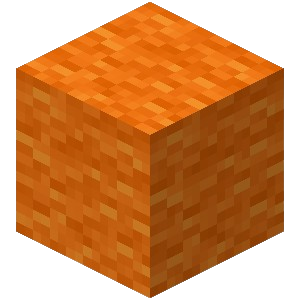
Acoustic Absorption: Wool Slabs inherit the defining trait of their parent block: vibration nullification. They stop Sculk vibrations, but they do not provide true acoustic sound-proofing. When placed, they prevent Sculk Sensors from detecting any vibrations caused by entities walking, items dropping, or blocks being placed/broken on or above them. This makes them superior to carpets (which only dampen partially) and equivalent to full wool blocks, but with half the vertical space.
Placement Flexibility:
-
Bottom Half: Placed on ground level; creates subtle "carpet-like" flooring without raised edges
-
Top Half: Placed at eye level; useful for ceilings and tables
-
Stacked: Two slabs of the same color create a full wool block, and two slabs of the same type form a full block, though this is less resource-efficient than crafting wool blocks directly
As a single slab, it occupies only half a block space. Some slabs can be waterlogged to create hidden water sources, and wool slabs can use that behavior for concealed builds.
Visual Palette: All 16 dye colors are supported (White, Orange, Magenta, Light Blue, Yellow, Lime, Pink, Gray, Light Gray, Cyan, Purple, Blue, Brown, Green, Red, Black), allowing for gradient flooring and color-coded silent zones.
Crafting Ingredient And Recipes
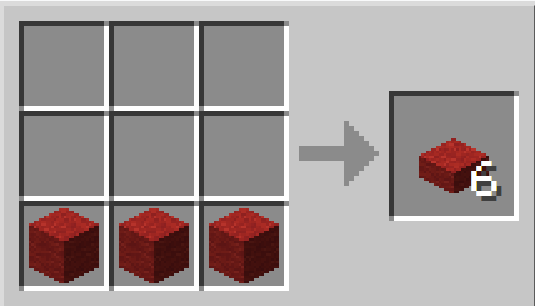
Raw Materials:
-
3 Wool Blocks (any matching color; the material must match the slab color output)
-
Crafting Table (2x2 grid insufficient)
Yield: 6 Wool Slabs crafted from three matching wool blocks at a crafting table, per craft
Alternative Acquisition:
-
Abandoned Camps: Generate naturally in 16 biomes, particularly Dappled Forest variants
-
Silk Touch: Not required; slabs break instantly and drop themselves with any tool
Step-By-Step Crafting
Grid Layout: Place three wool blocks in the bottom horizontal row (or any horizontal row) of the crafting table:
| EMPTY | EMPTY | EMPTY | ||
|---|---|---|---|---|
| EMPTY | EMPTY | EMPTY | = | 6 WOOL SLABS |
| WOOL | WOOL | WOOL | ||
| Survival Note: Since each slab effectively costs 0.5 wool blocks, this is the most resource-efficient way to cover large areas. A stack of 64 wool yields 128 wool slabs, enough to floor a 11x11 room (121 blocks) with leftovers. |
Mossy Stone Bricks Vs Wool Slabs
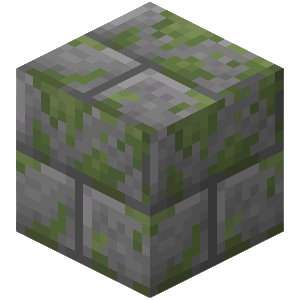
While both blocks offer aesthetic texture, their acoustic properties differ dramatically, with stone slabs also serving as a common comparison point for texture and utility:
| Property | Mossy Stone Bricks | Wool Slabs |
|---|---|---|
| Sound Dampening | None (full vibration transmission) | Complete (vibration nullification) |
| Durability | High (30 hardness) | Low (0.8 hardness, instant break) |
| Blast Resistance | 6 | 0.8 |
| Aesthetic | Rustic, ancient, cold | Soft, modern, warm |
| Redstone Conductivity | Opaque (blocks signals) | Transparent (top slabs allow signals through) |
| Verdict: Use Mossy Stone Bricks for rustic "quiet room" aesthetics where actual stealth is unnecessary; use Wool Slabs when you need guaranteed silence near Sculk Sensors or Wardens. |
Double Slab Mechanics
-
Formation: When stacking two wool slabs of the same type on the same level, a new entity, a Double Wool Slab, will be created. The visual appearance is very similar to standard Wool Blocks, but when it comes to gameplay features, things are different.
-
Drops: Dropping a Double Wool Slab gives 2 wool slabs at the same time. Previously, it gave you 1 wool block. This new feature is not revertible meaning once you turned the Double Wool Slab into wool slabs you can no longer use the original block in places where wool blocks are needed for a recipe.
-
Collision: The full size collision box of 1x1x1 for the double slabs means the block fills the full block space, unlike a single slab, and removes the easy step-up/jumping advantage used for mob spawning prevention and player movement control.
Placement And Redstone Interactions
Redstone Transparency:
-
Bottom Slabs: Act as opaque blocks; redstone dust runs along the top surface but cannot pass through vertically
-
Top Slabs: Act as transparent blocks; redstone signals can pass through them vertically, similar to glowstone or stairs
Concealment Strategy: Place Wool Slabs (particularly top-half placement) over redstone wiring to hide circuits while maintaining acoustic dampening. This creates "floating" redstone pathways that are both invisible from above and silent to Sculk detection.
Signal Pathing: Use bottom slabs to create raised silent walkways that do not interfere with underground redstone, or top slabs to allow daylight sensors to function through your soundproofing layer.
Sound Dampening Blocks: Practical Builds
The Silent Bedroom: Floor your sleeping quarters with White Wool Slabs (bottom half) instead of carpets. This prevents the bed itself from creating vibrations when players jump nearby, and eliminates the footstep sounds that might trigger a Sculk Shrieker in an Ancient City base.
The Recording Studio: Construct walls using Purple Wool Slabs (top half) facing outward with a 1-block air gap, then Orange Wool Slabs (bottom half) facing inward. This double-layered acoustic barrier completely isolates note blocks and jukeboxes from external Sculk Sensors while creating a visually striking studio aesthetic.
The Machine Enclosure: Surround noisy redstone contraptions (pistons, droppers, dispensers) with Gray Wool Slabs arranged as a 3x3 hollow cube. The slabs prevent vibration transmission while allowing item transport through the half-height gaps if needed.
Testing Method: Place a Sculk Sensor adjacent to your wool slab floor. Walk, jump, and drop items. The sensor should remain dormant (light level 0), confirming successful dampening.
Wool Slabs As Crafting Ingredient
While primarily decorative and functional, Wool Slabs serve as substitutes for full slabs in specific recipes, while wooden slabs also have utility as furnace fuel unlike wool slabs:
-
Composter: Any slab (including wool) can be used to craft a composter, though this is resource-inefficient compared to wooden slabs for building and crafting.
-
Lectern: Requires wooden slabs specifically; wool slabs cannot substitute.
-
Daylight Detector: Requires glass, quartz, and wooden slabs, wool slabs incompatible here.
-
Furnace Use: Wooden slabs can be used as fuel in furnaces.
-
Bedrock Edition: Wooden slabs can smelt 1.5 items per slab.
-
Note: Wool Slabs cannot be reverted to wool blocks or used to craft beds, banners, or carpets. Once slabbed, they remain slabs.
Performance And Mob Behavior
Mob Spawning: Bottom-half Wool Slabs prevent mob spawning on that block (the spawnable surface is below the slab's collision box). However, top-half slabs technically leave the bottom half "empty," which can allow mob spawning in the lower half-block if the light level permits. Always use bottom-half placement for spawn-proofing.
Light Transparency: Wool Slabs block light regardless of placement, maintaining the light-opacity of full wool blocks. This prevents mob spawning in dark rooms even when using top-half slabs, provided the light level is managed elsewhere.
Tips, Variants, And Troubleshooting
Layered Dampening: Combine Wool Slabs with Carpets placed on top for extra visual texture. The carpet does not negate the slab's dampening properties, and the combination creates a "plush" look perfect for luxury builds.
Rustic Hybrid: Mix Mossy Stone Bricks (for walls) with Brown or Green Wool Slabs (for floors) in "overgrown" builds, or blend in copper accents as another slab material for contrast. The stone provides structural narrative while the wool ensures the crumbling ruins remain silent to Sculk detection.
Troubleshooting:
-
Issue: Sculk Sensor still activates despite wool slab floor
-
Fix: Check for gaps between slabs; vibrations travel through empty spaces. Ensure complete coverage with no missing blocks.
-
Issue: Cannot place redstone on wool slabs
-
Fix: You are placing bottom slabs; redstone dust only sits on the top surface of blocks. Use top-half slabs if you need redstone to run along the "ceiling" of your space or place the dust on the ground beside the slabs.
-
Tip: Choosing slabs for utility
-
Fix: Wooden slabs can be used as fuel, while stone-based slabs cannot; they also burn less efficiently than a log.
Conclusion And Quick Reference
One-Line Craft: 3 Wool Blocks (horizontal row) = 6 Wool Slabs
Silent Build Checklist:
-
Cover all floor/wall surfaces with Wool Slabs (no gaps)
-
Use bottom-half slabs for spawn-proofing
-
Use top-half slabs if redstone transparency needed
-
Test with Sculk Sensor before declaring "safe"
-
Stack to 16 colors for visual coding (Red = danger zone, White = safe path)