How to Capture Minecraft Sulfur Cubes in Buckets: Step-By-Step Guide
Learn how to efficiently capture sulfur cubes in Minecraft buckets with this straightforward step-by-step guide. Start your adventure now!

Shahrukh Sial is a Gaming Content Strategist at Sparked Host. He identifies his own strategic outlines through deep research to cover game guides, tips, and updates that help players improve their skills and enjoy a better gaming experience.
Are you trying to figure out how to capture Minecraft Sulfur Cubes in buckets? You have likely stumbled into a Sulfur Cave, seen these strange yellow mobs jumping around, and wondered if they work like Slimes or Magma Cubes.
Here is the short answer: Yes, you can bucket them, but only under specific conditions.
In this comprehensive guide, we will walk you through the exact steps to safely locate, capture, and utilize Sulfur Cubes in both Java Edition and Bedrock Edition. Whether you are a redstone engineer looking for unique physics objects or wanting to fill your collection, this guide covers everything you need to know about the Minecraft Sulfur Cube pickup mechanic.
Important Safety Warning Before You Start
Before we dive into the tutorial, know this. Sulfur Caves are dangerous. They contain toxic gas, hazardous water, and mobs that can explode. Always bring the following items:
-
Fire Resistance Potions (Non-negotiable)
-
Milk Bucket (To cure poison or toxic exposure)
-
Empty Bucket (For capturing the mob)
-
Shears (For removing absorbed blocks)
What Is a Sulfur Cube in Minecraft?
A Sulfur Cube is a passive mob introduced in the Chaos Cubed update that spawns exclusively in Sulfur Caves. Unlike Slimes or Magma Cubes, Sulfur Cubes are passive and have the unique ability to absorb blocks, which changes their physical properties such as bounce, slide, weight, or even explosiveness.
Key Differences from Other Cube Mobs:
| Feature | Slime | Magma Cube | Sulfur Cube |
|---|---|---|---|
| Behavior | Hostile | Hostile | Passive |
| Spawn Location | Swamps, Slime Chunks | Nether | Sulfur Caves Only |
| Block Absorption | No | No | Yes |
| Bucketable | No | No | Yes (Large Only) |
Pro Tip: Only large Sulfur Cubes can be captured in buckets. Small Sulfur Cubes, which spawn when a large one dies, cannot be bucketed until they grow up.
Step 1: Locate a Sulfur Cave Biome
You will not find Sulfur Cubes in regular caves or the Nether. They spawn exclusively in the Sulfur Cave biome, a rare underground generation.
How to Find Sulfur Caves: Surface Clues
While Sulfur Caves are underground, there are surface indicators that one is nearby:
-
Yellow-tinted water pools (Sulfur Springs)
-
Yellow staining on grass or stone surfaces
-
Cinnabar ore deposits (Red-orange mineral clusters)
-
Yellow particle effects (Sulfur gas vents)
If you spot these signs, do not dig straight down. Instead, dig at an angle or use ladder shafts to safely reach depths between Y-level 20 and -40, where Sulfur Caves typically generate.
Visual Markers Inside Sulfur Caves
Once inside, you will recognize a Sulfur Cave by:
-
Yellow-tinted walls with sulfur deposits
-
Toxic-looking water pools (avoid contact)
-
Sulfur Cubes jumping around (they spawn at any light level)
-
Unique vegetation like yellow mushrooms and cinnabar crystals
Step 2: Prepare Your Capture Kit
Before attempting to capture a Sulfur Cube, ensure you have the following items in your inventory:
Essential Items:
-
Empty Bucket: Required for capturing the mob
-
Shears: To remove any absorbed blocks from the cube
-
Fire Resistance Potion/Armor: Critical for survival
-
Milk Bucket: Antidote for toxic exposure
Recommended Gear:
-
Lead: For transporting cubes that have absorbed blocks (more on this later)
-
Building Blocks: To create safe paths or block hazardous geysers
-
Slimeballs: If you plan to breed or accelerate cube growth
-
Golden Dandelions: To stop small cubes from growing (if needed)
Step 3: How to Capture a Sulfur Cube in a Bucket (Step-by-Step)
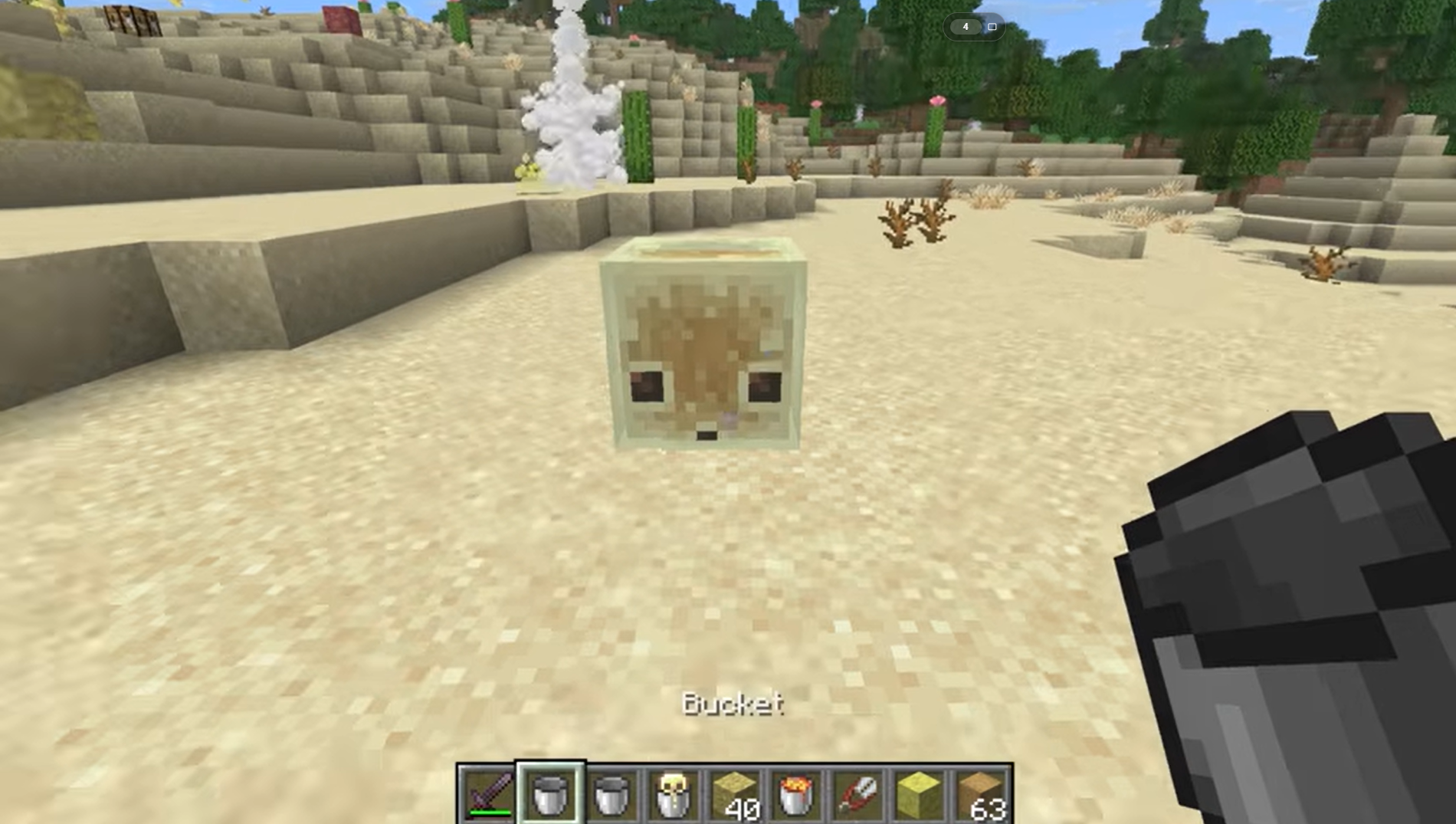
This is the core mechanic you have been waiting for. Follow these steps exactly to successfully capture a Sulfur Cube.
Step 3.1: Identify a Targetable Cube
-
Look for a large Sulfur Cube (approximately 1 block in size)
-
Ensure the cube does not have an ignited TNT block absorbed (it will be flashing or primed)
-
Verify the cube is not currently holding a Magma Block (it will damage you if you get too close)
Warning: If a Sulfur Cube has absorbed TNT and it is ignited, you cannot bucket it. It will explode if you try. Back away immediately.
Step 3.2: Equip Your Empty Bucket
Open your inventory and place the empty bucket in your hotbar. Select it so you are holding it in your hand.
Step 3.3: Perform the Capture
-
Java Edition: Right-click on the large Sulfur Cube
-
Bedrock Edition: Press the interact button (usually LT/L2 or tap on mobile) while looking at the cube
If successful, the Sulfur Cube will disappear, and your empty bucket will transform into a "Bucket of Sulfur Cube" item.
Step 3.4: Verify Your Capture
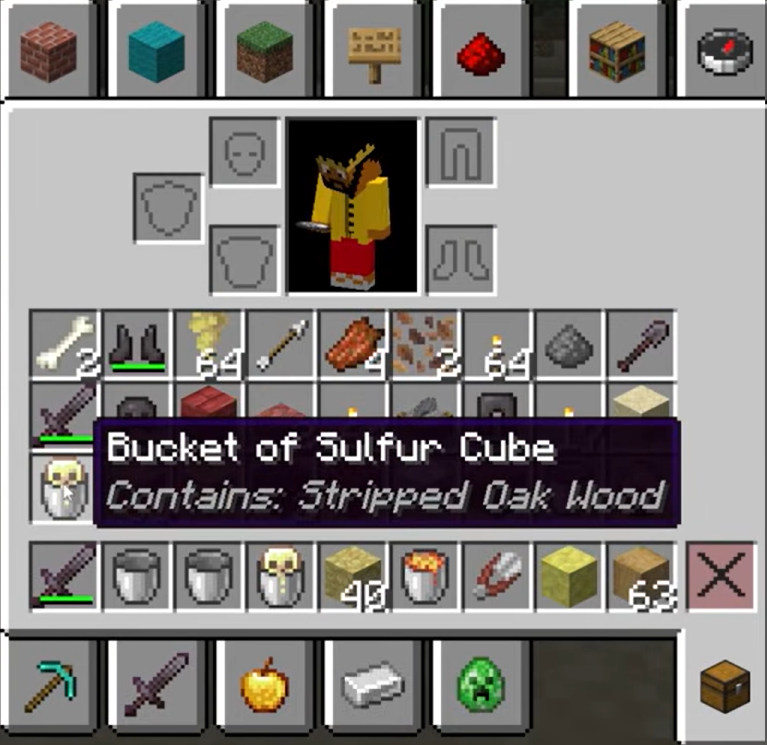
Check your inventory. You should see:
-
"Bucket of Sulfur Cube" (if unnamed)
-
"[Cube's Name]" (Java Edition) or "Bucket of [Cube's Name]" (Bedrock Edition) if the cube was named
-
A tooltip showing the absorbed block type (unless the cube is named)
Note: Bucketed Sulfur Cubes do not count toward mob caps and will not despawn, making them safe for long-term storage.
Common Mistakes to Avoid (And How to Fix Them)
Even experienced players run into issues. Here are the most common problems and their solutions:
Problem: "I can't bucket the Sulfur Cube" Solution: You are likely trying to bucket a small Sulfur Cube. Only large cubes can be captured. Small cubes must grow up first (20 minutes naturally, or faster with slimeballs).
Problem: "My bucket disappeared and I didn't get the cube" Solution: You may have interacted incorrectly, or the cube had an absorbed block that prevented capture (like ignited TNT). Always verify the cube's state before attempting.
Problem: "The cube exploded when I tried to capture it" Solution: The cube had absorbed TNT and was ignited. Never approach or attempt to bucket a cube with primed TNT.
Problem: "I can't remove the absorbed block" Solution: Use shears on the cube to extract the block. If the TNT is already ignited, it is too late. Run.
Advanced: Understanding Absorbed Blocks and Archetypes
One of the most unique features of Sulfur Cubes is their ability to absorb blocks, which grants them different physical properties. This is crucial for redstone engineers and builders.
Dangerous Archetypes (Handle with Extreme Care):
-
TNT (Explosive): Can be ignited to create explosions. Damage varies by difficulty (29HP on Easy, 56HP on Normal, 84.5HP on Hard).
-
Magma Block (Hot): Damages nearby entities automatically.
Physics-Changing Archetypes:
-
Ice/Packed Ice: Makes the cube slide without bouncing
-
Honeycomb Block: Prevents all movement (sticky)
-
Wool: Gives the cube floaty, low-gravity behavior
-
Iron/Gold Blocks: Increases gravity, making the cube heavy and immobile
Pro Tip: If you need to remove an absorbed block, use shears on the cube. The block will drop as an item you can collect. Alternatively, killing the cube will also drop the block, but this destroys the mob.
Redstone Applications: Using Sulfur Cubes in Builds
Sulfur Cubes offer unique opportunities for redstone engineers.
Dispenser-Based Spawning Systems:
You can create automated systems that spawn Sulfur Cubes using dispensers:
-
Place a dispenser facing your desired spawn location
-
Load "Bucket of Sulfur Cube" items into the dispenser
-
Activate with a redstone signal to release the cube
Safety Mechanisms:
-
Use pressure plates to detect escaped cubes
-
Implement emergency stop buttons to deactivate dispensers
-
Create containment chambers with unbreakable materials for explosive archetypes
Testing Facilities: Build isolated testing areas for experimenting with different block archetypes. Always test in creative mode first before implementing in survival worlds.
Bedrock Edition vs. Java Edition: Key Differences
While the core mechanics are similar, there are important differences between editions:
Naming Conventions:
-
Java Edition: Named bucketed cubes show only the name (for example, "MyCube")
-
Bedrock Edition: Named bucketed cubes show "Bucket of [Name]" (for example, "Bucket of MyCube")
Physics Differences:
-
Bedrock Edition: Sulfur Cubes are knocked further when launched while airborne
-
Java Edition: Airborne knockback behaves differently (less vertical displacement)
Technical Implementation:
-
Java Edition: Uses #sulfur_cube_swallowable and #sulfur_cube_archetype/* tags
-
Bedrock Edition: Uses #minecraft:sulfur_cube_archetype_* tags
Important: Cross-platform compatibility is limited. Bucketed Sulfur Cubes may not transfer correctly between Java and Bedrock and absorbed block data may be lost.
Frequently Asked Questions (FAQ)
Can I breed Sulfur Cubes?
No, Sulfur Cubes cannot be bred. However, when a large Sulfur Cube dies, it splits into two small cubes. These small cubes can be fed slimeballs to accelerate their growth into large cubes.
Do Sulfur Cubes drop music discs?
No, Sulfur Cubes do not drop music discs or any rare loot. Their primary value is in their unique mechanics and block absorption capabilities.
Can I transport Sulfur Cubes with leads?
Only if they have absorbed a block. Large Sulfur Cubes without absorbed blocks cannot be leached. However, once captured in a bucket, they can be transported safely and released anywhere.
How long does it take for a small Sulfur Cube to grow?
Small Sulfur Cubes take 20 minutes to grow into large cubes naturally. This can be accelerated by feeding them slimeballs.
Are Sulfur Cubes hostile?
No, Sulfur Cubes are passive mobs. They will not attack players under any circumstances. However, cubes with absorbed Magma Blocks or TNT can indirectly cause harm.
Final Tips for Success
-
Always test in creative mode before implementing Sulfur Cube mechanics in survival
-
Backup your world before experimenting with explosive archetypes
-
Label your storage clearly if you are keeping multiple bucketed cubes
-
Never work alone with explosive or hot archetype cubes
-
Keep fire resistance active at all times in Sulfur Caves
Conclusion
Capturing Minecraft Sulfur Cubes in buckets is a unique mechanic that opens up exciting possibilities for redstone engineering, physics experiments, and collection. By following this guide, you now know exactly how to locate Sulfur Caves, prepare the necessary gear, and safely capture these fascinating mobs.
Remember: Safety first. Sulfur Caves are hazardous environments, and Sulfur Cubes with certain absorbed blocks can be dangerous. Always prioritize your safety and test mechanics in controlled environments.
Ready to start your Sulfur Cube collection? Head to the nearest Sulfur Cave (if you dare) and begin your adventure.