Exploring How Do Sulfur Cubes Behave in Minecraft
Discover how sulfur cubes behave in Minecraft, their uses, and tips for effective gameplay. Dive into the guide to enhance your gaming experience!

Shahrukh Sial is a Gaming Content Strategist at Sparked Host. He identifies his own strategic outlines through deep research to cover game guides, tips, and updates that help players improve their skills and enjoy a better gaming experience.
The Chaos Cubed update added a new mob called the Sulfur Cube. These are not just normal creatures found in the game. They act like programmable physics objects. Because they react to the environment, they can change the way you approach redstone engineering, base defense, and player transportation.
This guide serves as a comprehensive breakdown for players looking to master the mechanics of the sulfur cube introduced in the Chaos Cubed update. Whether you are a dedicated technical builder aiming to optimize your automated transport networks or a casual adventurer curious about the strange entities inhabiting the new caves, the information provided here will ensure you understand how to safely capture, manage, and utilize these programmable creatures.
By following these details, you can move beyond simple mob interaction and begin using these entities as functional physics components within your world.
Why Sulfur Cubes Matter to Your Gameplay
The introduction of the sulfur cube changes the fundamental way players interact with the game. In previous versions, physics-based movement was largely restricted to entities like boats or minecarts, which operate on rigid track systems or specific entity collision rules.
Sulfur cubes break this mold by acting as versatile, status-changing objects that adapt to the blocks they hold. For the reader, this matters because it unlocks new tiers of efficiency for base defense, vertical transportation, and creative minigame design.
Mastering these mobs is no longer just about combat or collection; it is about learning to integrate a dynamic, physics-driven tool into your existing infrastructure to solve engineering problems that were previously unsolvable.
How Sulfur Cubes Behave in Sulfur Caves in Minecraft
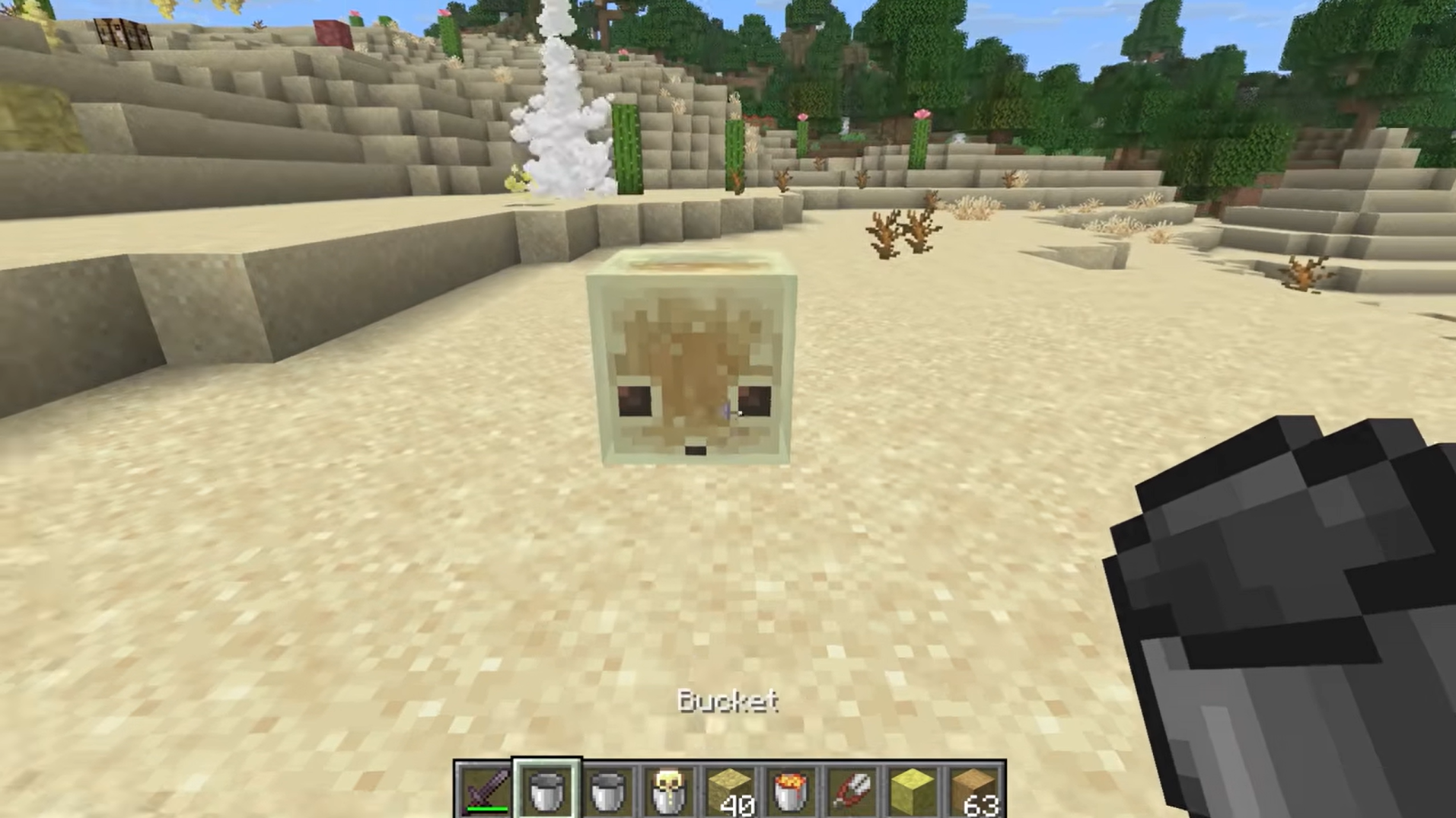
You need to know how these mobs act so you can use them well. They have two main ways of behaving. Understanding these states is the first step to becoming a master engineer with these entities.
State 1: Passive Mode (Default Behavior)
When a large Sulfur Cube has not eaten a block, only the large ones can absorb blocks, while small ones cannot, so it is in passive mode. In this state, it just jumps around aimlessly. It can also climb up things like vines, ladders, or other climbable blocks. Because it has not eaten anything yet, it is easy to hurt. You can find them only in Sulfur Caves, which are filled with yellow sulfur and red cinnabar blocks, shallow pools of water, sulfur spikes, and other yellow blocks, where they spawn at any light level.
If you defeat one, it will split into two small sulfur cubes. These small sulfur cubes do not drop experience points. They are essentially babies that will grow into large cubes after twenty minutes. You can speed up this process by feeding them slimeballs. If you want them to stay small forever for decoration, you can feed them a golden dandelion to stop their growth.
State 2: Absorbed Mode (Transformed Behavior)
When a large Sulfur Cube eats a block, it changes. First, it can absorb a block and becomes completely still instead of jumping around. The absorbed block it ate will show up inside the cube, which is visually distinct, and that block acts as one of the modifiers to its behavior. Second, it becomes very tough. It will not take damage from most common attacks like swords, arrows, or even falling blocks like anvils. Instead of taking damage, players can hit an absorbed cube around like a ball, and where you strike its body affects the direction it moves. This is called knockback.
The way it moves after being hit depends on the specific sulfur cube archetypes. For example, some blocks make it slide, while others make it bounce. Additionally, the absorbed block can change its properties through different modifiers, and absorbing TNT can give it explosion behavior based on proximity. This allows you to treat the cubes as a physics component. Even though it is tough, things like fire, suffocation, the Wither effect, or the sonic boom from a Warden can still kill it. Players can remove absorbed blocks with shears, or recover the block by killing the cube, with the sole exception of ignited TNT.
The Science of Launching and Physics
Understanding how the cube moves when hit is important for building good machines. When a cube is hit, it launches based on the direction of the attack. If you hit it on one side, it flies to the other side. The harder the hit, the further it flies. You can even use enchantments like Knockback or Punch to make your machines more powerful.
Strategic Uses for Sulfur Cubes
Because these cubes react to physics, they are useful tools for engineering and building.
Automated Transportation Systems
You can build complex machines to move items or players quickly. If a cube eats wood, it becomes bouncy. You can use this to make high jump launch pads. If it eats ice, it becomes very slippery. You can use this to make long sliding tracks that move the cube across great distances with very little friction. Because these cubes are entities that follow physics, they can be pushed by pistons or launched by slime blocks to create dynamic transit networks.
Visual Displays and Illusions
These cubes can be used for decoration. If you throw a potion of invisibility at a cube, the cube itself will vanish. Only the block inside will stay visible. This makes it look like a block is floating in mid-air. While light blocks like froglights will glow, they do not actually provide light to the surrounding blocks. This is perfect for creating floating light fixtures that do not require torches.
Defensive Structures
You can use these cubes to protect your base from intruders. If a cube eats a magma block, it becomes hot. It will then hurt any nearby monsters, acting as a living damage zone. If it eats soul sand, it becomes very hard to move. This makes it a great barrier that keeps enemies away from your doors. Since they are immune to melee damage, they can act as a shield against hostile mobs while they hold their ground.
Explosive Mechanisms
A cube can eat a TNT block. Once it does, you can set it off with redstone, fire, or other explosions. It will then explode just like a TNT block. This is useful for making secret traps or clearing out large areas for construction. Unlike normal TNT, you can trigger these ignited TNT cubes using redstone signals or by hitting them with weapons that have the Fire Aspect enchantment.
Physics-Based Puzzles and Minigames
You can use these cubes to make fun challenges for your friends. You can set up obstacle courses that require the right type of cube to solve. For instance, a player might need to pick up a bouncy cube to reach a high ledge or a heavy cube to press down a pressure plate. The variety of sulfur cube archetypes means you can design endless puzzles where the player must identify and swap the blocks inside the cubes to proceed.
Essential Maintenance and Handling
Building machines is only half the battle. You also need to know how to keep your cubes safe and organized.
Always Name Your Sulfur Cubes
Always use a name tag on your cube. This ensures it will not disappear when you walk away or when the game cleans up excess mobs. If the cube splits while it has a name, the small cubes will keep that name. This is essential for long-term builds where you need your components to stay exactly where you put them.
Understand Sulfur Cube Archetype Properties
Every block gives the cube different powers based on its archetype. Here is a list of what you should know:
-
Bouncy: Planks, logs, or bamboo make the cube bounce often.
-
Sticky: Honeycomb blocks make the cube stop moving or sliding.
-
Fast Sliding: Blue ice or packed ice makes the cube slide but not bounce.
-
Heavy: Iron or gold blocks make the cube heavy, meaning it does not get knocked back very far.
-
Light: Wool makes the cube floaty because it lowers its gravity.
-
Hot: Magma blocks damage nearby creatures.
-
Explosive: TNT allows for controlled detonations.
Use Shears for Safe Block Removal
Do you want to get your block back or change the cube's behavior? Simply use shears on the cube. This will pop the block out without hurting or killing the cube. You can also use a dispenser with shears to do this automatically. This is a very powerful way to cycle through different physics behaviors in a single machine.
Account for Bedrock Edition Differences
The game acts a bit differently depending on whether you play Java or Bedrock Edition. For instance, the way cubes fly in the air is not exactly the same. In Bedrock, they are often knocked much higher into the air. In Java, they retain their climbing ability even when launched, which is not true for Bedrock. Always test your machines in the version of the game you use most.
Safety First with Dangerous Archetypes
Working with TNT and magma can be risky. Always build your tests in a safe, isolated area or a creative world. Keep fire extinguishing items like water buckets or sand nearby, too. Remember that even though the cube is immune to magma, it is still vulnerable to fire and other environmental hazards.
Efficient Transport and Storage
The best way to move a large cube is with an empty bucket. This turns it into an item you can carry in your inventory. This also saves space in your world because bucketed cubes do not count toward the mob limit and will not despawn. This is the most efficient way to collect them from the Sulfur Caves and bring them back to your base.
Managing Small Sulfur Cubes
Small cubes are like babies. They cannot eat blocks. They grow into large cubes after 20 minutes. You can feed them slimeballs to speed up their growth time. Or, if you want them to stay small forever for decoration, feed them a golden dandelion to stop them from growing. Be careful, as small cubes do not have the same damage resistance as their larger parents.
Testing Protocol
Before you build a massive machine, test it in a creative world first. Make sure you understand how the specific block archetype interacts with the environment. If you are going to try something dangerous, always back up your world save file, so your hard work is safe in case something goes wrong. Documenting your successful configurations will help you build better machines in the future.
Conclusion
Sulfur Cubes are a great way to add fun physics to your game. By learning which blocks they like and how they move, you can build amazing, automated contraptions that were never possible before. Whether you are building a fast transportation tunnel, a protective wall, or a complex puzzle for a minigame, these creatures offer endless potential.
Just remember to name them, test your ideas in a safe space, and pay attention to which edition of the game you are playing. Are you ready to start building with these new mobs and harness the chaos?