What Blocks Can Sulfur Cubes Absorb in Minecraft
Discover what blocks sulfur cubes can absorb in Minecraft. Enhance your gameplay with this complete guide. Read more to optimize your strategies!

Shahrukh Sial is a Gaming Content Strategist at Sparked Host. He identifies his own strategic outlines through deep research to cover game guides, tips, and updates that help players improve their skills and enjoy a better gaming experience.
The ability of a Sulfur Cube to absorb a block is its most defining trait, transforming it from a simple jumping mob into a functional engineering component. By consuming a full-sized block, the creature adopts the physical properties associated with that material, effectively allowing you to customize the behavior of the mob to suit your specific project needs.
This absorption process is categorized into twelve distinct archetypes, each dictating how the cube interacts with the world around it. Whether you require a bouncy projectile to launch across a gap, a stationary block of hot magma to defend your base, or a sliding surface to transport items, there is a specific material suited to the task.
Mastering this mechanic requires a deep understanding of which materials belong to which category. This guide serves as a comprehensive reference for all absorbable blocks, detailing their archetypes and the unique physical behaviors they unlock. By learning how these materials influence your cubes, you can begin to design machines and contraptions that utilize these mobs in highly innovative ways.
Section 1: List of Block Absorption and Absorbable Blocks
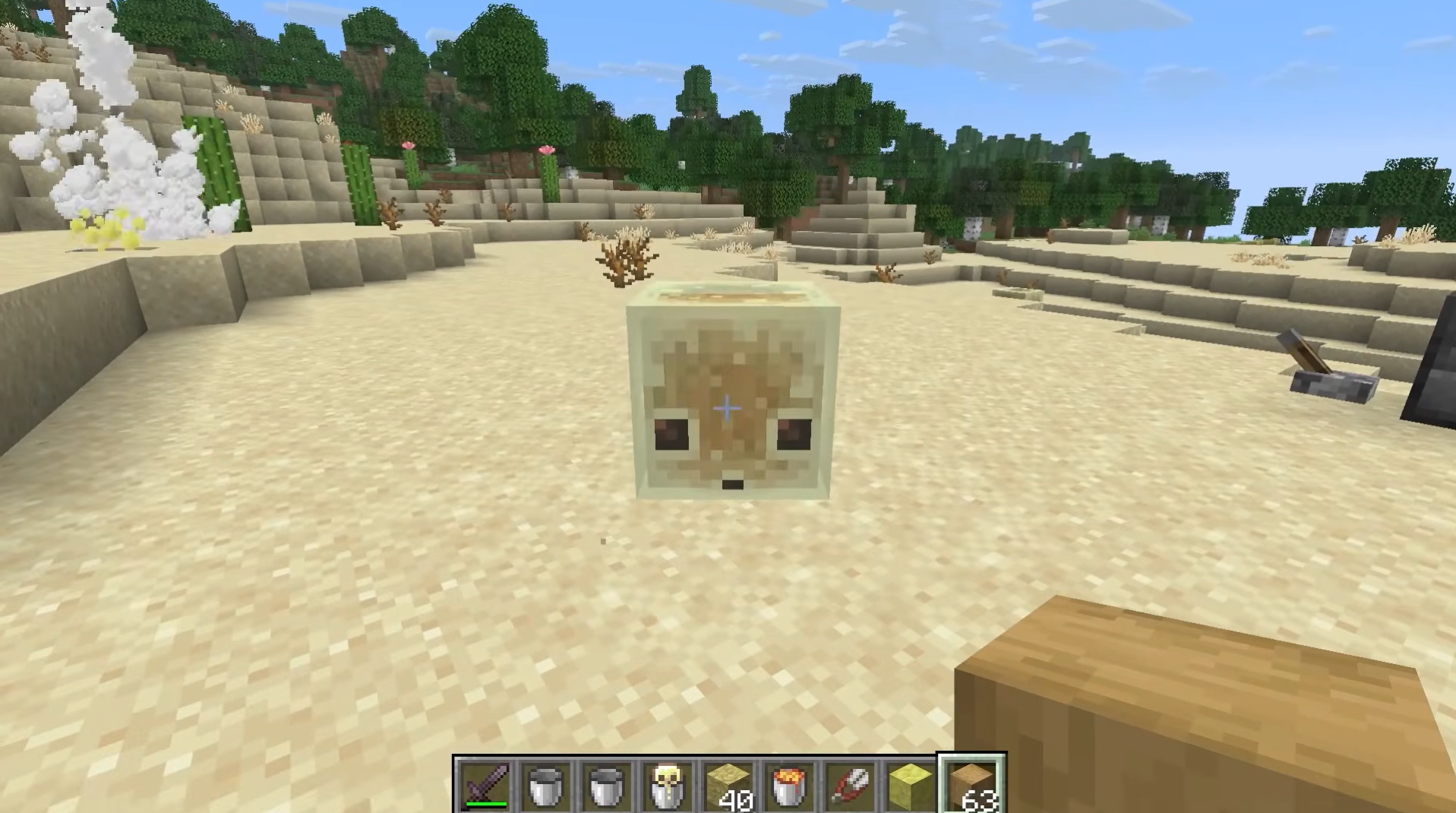
Sulfur Cubes can only absorb specific blocks, which are categorized into different archetypes. Large Sulfur Cubes are passive slime-like mobs found in sulfur caves. Here is the complete list of absorbable blocks: Once block absorption happens, the cube becomes damage-immune while it has an absorbed block.
Shears can safely remove the absorbed block from a Sulfur Cube without triggering unwanted effects, while killing it may drop the block but is usually a poor trade.
Bouncy Archetype:
-
Planks (all types)
-
Bamboo Mosaic
-
Logs (all types)
-
Stripped Logs (all types)
-
Wood (all types)
-
Stripped Wood (all types)
-
Block of Bamboo
-
Block of Stripped Bamboo
Explosive Archetype:
- TNT
Fast Flat Archetype:
-
Coral Blocks (all types)
-
Dead Coral Blocks (all types)
-
Sponge
-
Wet Sponge
-
Dried Kelp Block
-
Moss Block
-
Pale Moss Block
-
Block of Resin
-
Resin Bricks
-
Chiseled Resin Bricks
-
Pumpkin
-
Melon
-
Hay Bale
-
Carved Pumpkin
-
Jack o'Lantern
-
Froglights
Fast Sliding Archetype:
-
Blue Ice
-
Packed Ice
-
Snow Block
High Resistance Archetype:
-
Soul Sand
-
Soul Soil
Hot Archetype:
- Magma Block
Light Archetype:
- Wool (all types)
Slow Bouncy Archetype:
- Stone and most stone-like blocks
Slow Flat Archetype:
-
Block of Iron
-
Block of Gold
-
Block of Raw Copper
-
Block of Raw Gold
-
Block of Raw Iron
-
Gold Ore
-
Nether Gold Ore
-
Iron Ore
-
Copper Ore
-
Block of Netherite
-
Ancient Debris
-
Block of Copper
-
Copper Bulb
-
Cut Copper
-
Chiseled Copper
Slow Sliding Archetype:
-
Brown Mushroom Block
-
Red Mushroom Block
-
Mushroom Stem
-
Mycelium
-
Nether Wart Block
-
Warped Wart Block
-
Shroomlight
Sticky Archetype:
- Honeycomb Block
Regular Archetype:
-
Concrete Powder
-
Mud
-
Muddy Mangrove Roots
-
Packed Mud
-
Block of Coal
-
Dirt
-
Coarse Dirt
-
Rooted Dirt
-
Podzol
-
Grass Block
-
Clay
-
Bone Block
Section 2: Archetype Categories and Sulfur Cube Archetype
Each sulfur cube archetype can be activated by feeding it a block, and the names give you a basic idea of the effect because each one changes the Sulfur Cube’s friction, bounciness, and air drag:
-
Bouncy: High elasticity, good for launching, and when moved it behaves more like a ball.
-
Explosive: Can be ignited with TNT to trigger explosions.
-
Fast Flat: Slides easily, minimal bouncing.
-
Fast Sliding: Maximum sliding, no bouncing.
-
High Resistance: Hard to move, absorbs impact.
-
Hot: Damages nearby entities.
-
Light: Floaty, low gravity effects.
-
Slow Bouncy: Moderate bouncing, slow movement; if hit, it may jump or move differently depending on the absorbed block.
-
Slow Flat: Heavy, minimal movement.
-
Slow Sliding: Slow sliding, no bouncing.
-
Sticky: No movement sticks to surfaces.
-
Regular: Standard physics behavior.
Conclusion: Gameplay Uses and Physical Properties
The variety of absorbable blocks allows for numerous gameplay applications:
-
Engineering: Activate a sulfur cube archetype by placing the needed block directly onto the mob, and dispensers can automate the swap by dropping it onto the cube.
-
Transportation: Players can carry Sulfur Cubes in buckets, or use sliding and bouncing archetypes for moving items.
-
Defense: Utilize hot or explosive archetypes for automated defense, with ignited TNT as the sole exception because it cannot be handled safely like other absorbed blocks.
-
Puzzles: Design challenges using specific block properties.
-
Decoration: Create unique visual effects with different absorbed blocks.
You can also drop a block on the ground near a cube, or directly onto it, to trigger block changes.
This is especially useful for switching small sulfur cubes between roles without making them split.
Understanding which blocks can be absorbed, and their effects enables players to maximize the potential of Sulfur Cubes in their projects, while these extra features make them more flexible in play.